
Master Mindful Breathing: Boost Focus & Productivity 15% This Quarter
In today’s fast-paced world, where demands are high and distractions are constant, maintaining focus and maximizing productivity can feel like an uphill battle. We’re constantly bombarded with information, notifications, and an ever-growing to-do list, leading to stress, burnout, and a significant dip in our ability to perform at our best. But what if there was a simple, yet profoundly effective, tool you already possess that could revolutionize your concentration and output? The answer lies in the ancient practice of Mindful Breathing Techniques. This isn’t just about ‘taking a deep breath’; it’s about harnessing the power of your breath to regulate your nervous system, sharpen your cognitive functions, and ultimately, drive a measurable increase in your focus and productivity.
Imagine being able to cut through the mental fog, silence the inner critic, and approach tasks with a laser-like focus that allows you to accomplish more in less time. This isn’t a pipe dream; it’s an attainable reality through consistent application of Mindful Breathing Techniques. Numerous studies have demonstrated the profound impact of mindful breathing on cognitive performance, emotional regulation, and stress reduction. By consciously directing your breath, you activate your parasympathetic nervous system, shifting your body from a state of ‘fight or flight’ to one of ‘rest and digest.’ This physiological shift has a direct positive correlation with your ability to concentrate, make decisions, and retain information.
This comprehensive guide will walk you through a practical 3-step approach to integrate Mindful Breathing Techniques into your daily routine. Our goal is not just to introduce you to these practices, but to empower you to implement them effectively, aiming for a tangible 15% increase in your focus and productivity within this quarter. Whether you’re a student, a busy professional, or simply someone looking to enhance their daily performance, mastering these techniques will provide you with an invaluable skill set for navigating the complexities of modern life with greater calm and efficiency. Let’s embark on this transformative journey to unlock your full potential through the power of mindful breath.
Understanding the Science Behind Mindful Breathing for Enhanced Focus
Before diving into the practical steps, it’s crucial to understand why Mindful Breathing Techniques are so effective. It’s not magic; it’s rooted in robust physiological and psychological principles. Our breath is intrinsically linked to our autonomic nervous system, which controls involuntary bodily functions like heart rate, digestion, and stress response. This system has two main branches: the sympathetic (responsible for ‘fight or flight’) and the parasympathetic (responsible for ‘rest and digest’).
When you’re stressed, anxious, or overwhelmed, your sympathetic nervous system is typically in overdrive. This leads to shallow, rapid breathing, increased heart rate, muscle tension, and a release of stress hormones like cortisol. While this response is vital in genuinely dangerous situations, chronic activation in non-threatening scenarios impairs cognitive function. You might experience difficulty concentrating, poor memory recall, and heightened emotional reactivity.
Conversely, deliberate, slow, and deep breathing (the hallmark of Mindful Breathing Techniques) stimulates the vagus nerve, which is a major component of the parasympathetic nervous system. Activating the vagus nerve sends signals to your brain that it’s safe to relax. This cascade of physiological changes includes:
The Autonomic Nervous System and Your Breath
When you’re stressed, anxious, or overwhelmed, your sympathetic nervous system is typically in overdrive. This leads to shallow, rapid breathing, increased heart rate, muscle tension, and a release of stress hormones like cortisol. While this response is vital in genuinely dangerous situations, chronic activation in non-threatening scenarios impairs cognitive function. You might experience difficulty concentrating, poor memory recall, and heightened emotional reactivity.
Conversely, deliberate, slow, and deep breathing (the hallmark of Mindful Breathing Techniques) stimulates the vagus nerve, which is a major component of the parasympathetic nervous system. Activating the vagus nerve sends signals to your brain that it’s safe to relax. This cascade of physiological changes includes:
- Decreased Heart Rate: A slower heart rate promotes a sense of calm.
- Lowered Blood Pressure: Reduces physical tension and stress.
- Increased Oxygen to the Brain: Deeper breaths ensure more oxygen reaches your brain, optimizing its function and enhancing clarity.
- Reduced Cortisol Levels: Muting the stress response helps improve mood and cognitive performance.
- Enhanced Neuroplasticity: Regular mindful breathing can actually rewire your brain, strengthening areas associated with attention, emotional regulation, and self-awareness.
The Link Between Breath and Attention
Beyond the physiological shifts, mindful breathing directly trains your attention. When you focus on your breath – its sensation, rhythm, and depth – you are actively engaging your prefrontal cortex, the part of the brain responsible for executive functions like planning, decision-making, and sustained attention. This practice is essentially a mental workout for your focus muscles. By repeatedly bringing your attention back to your breath when your mind wanders, you strengthen your ability to sustain focus on any given task, a critical skill for boosting productivity.
Moreover, Mindful Breathing Techniques help you cultivate metacognition – awareness of your own thought processes. You become better at noticing when your mind is distracted, allowing you to gently guide it back to the present moment and the task at hand. This improved self-awareness is invaluable for identifying and mitigating internal distractions that often derail our productivity.
Understanding these underlying mechanisms empowers you to approach mindful breathing not just as an exercise, but as a strategic tool for optimizing your brain and body. With this foundation, let’s explore the practical steps to integrate these powerful techniques into your daily life and achieve that 15% boost in focus and productivity.
Step 1: The Foundation – Diaphragmatic Breathing (Belly Breathing)
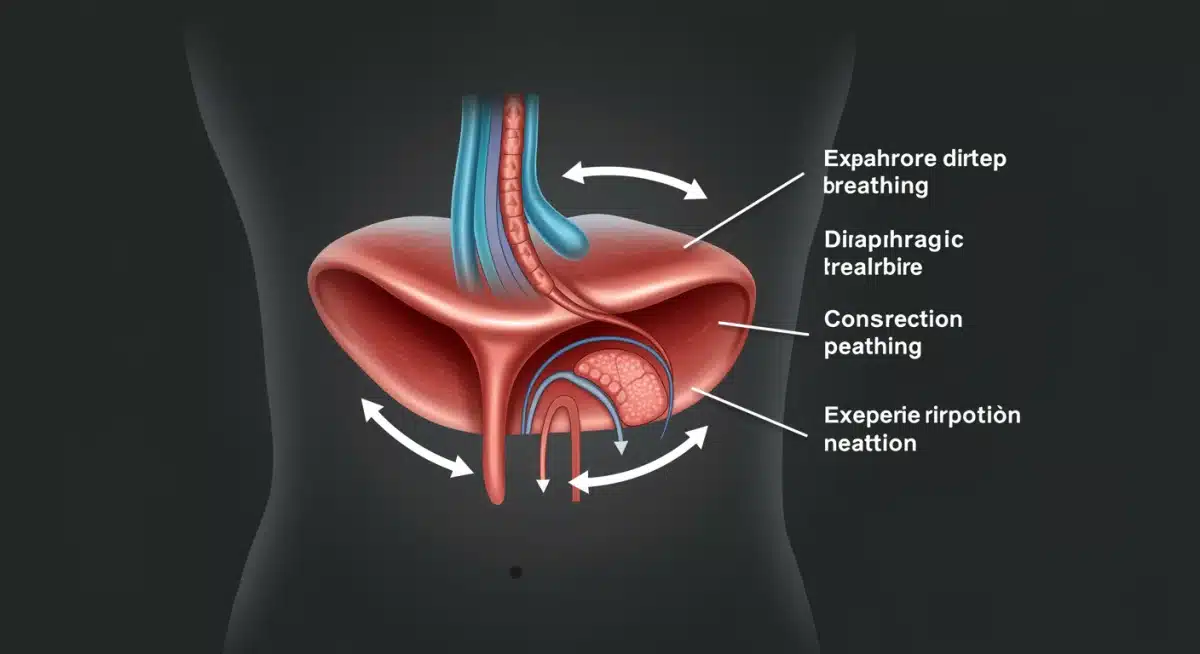
The cornerstone of all effective Mindful Breathing Techniques is diaphragmatic breathing, often referred to as ‘belly breathing.’ Unlike shallow chest breathing, which is often a symptom of stress, diaphragmatic breathing engages your diaphragm, a dome-shaped muscle located at the base of your lungs. This method allows for deeper, more efficient oxygen exchange and directly stimulates the vagus nerve, initiating the relaxation response.
How to Practice Diaphragmatic Breathing: The Basics
- Find a Comfortable Position: Lie down on your back with your knees bent and feet flat on the floor, or sit upright in a chair with good posture. Place one hand on your chest and the other on your abdomen, just below your rib cage. This helps you feel the movement.
- Inhale Slowly Through Your Nose: Take a deep, slow breath through your nose. As you inhale, focus on expanding your abdomen. You should feel the hand on your belly rise, while the hand on your chest remains relatively still.
- Exhale Slowly Through Pursed Lips: Gently contract your abdominal muscles as you exhale slowly through slightly pursed lips, as if you’re blowing through a straw. Feel the hand on your belly fall. The exhalation should be longer than your inhalation.
- Focus on the Sensation: Pay close attention to the sensation of your breath – the cool air entering your nostrils, the expansion of your belly, the warm air leaving your mouth. If your mind wanders, gently bring it back to your breath.
- Duration: Start with 5-10 minutes per session. Aim for 3-5 sessions throughout your day, especially before demanding tasks or when you feel stressed.
Why is this the foundation? Many people breathe shallowly from their chest, which can exacerbate anxiety and reduce oxygen intake. Diaphragmatic breathing reverses this pattern, training your body to breathe more efficiently and calmly. Regular practice builds a strong foundation for more advanced Mindful Breathing Techniques and prepares your mind for sustained focus.
Integrating Diaphragmatic Breathing into Your Day
To truly see a 15% increase in focus and productivity, consistency is key. Don’t relegate this practice to just a morning or evening routine. Look for opportunities to integrate short bursts of diaphragmatic breathing throughout your day:
- Before Starting Work: Spend 2-3 minutes practicing before diving into your first task. This sets a calm and focused tone.
- During Breaks: Instead of checking social media, take a 5-minute breathing break.
- Before Meetings or Presentations: Calm your nerves and improve clarity of thought.
- When Feeling Overwhelmed: A few rounds of deep belly breaths can quickly diffuse stress.
The goal is to make diaphragmatic breathing a natural response, shifting your nervous system into a more receptive state for work and learning. This foundational step is crucial for unlocking the full potential of more dynamic Mindful Breathing Techniques.
Step 2: The Enhancement – The 4-7-8 Breathing Technique
Once you’ve established a comfortable rhythm with diaphragmatic breathing, you’re ready to enhance your practice with the 4-7-8 breathing technique. Developed by Dr. Andrew Weil, this specific rhythm acts as a natural tranquilizer for the nervous system, making it an incredibly potent tool among Mindful Breathing Techniques for quickly reducing stress, improving focus, and even aiding sleep. It’s particularly effective when you need a rapid shift in your state, perhaps before a challenging task or when fighting off distractions.
How to Practice 4-7-8 Breathing
- Preparation: Sit or lie in a comfortable position. Place the tip of your tongue against the ridge of tissue just behind your upper front teeth, and keep it there throughout the entire breathing exercise.
- Exhale Completely: Exhale completely through your mouth, making a gentle ‘whoosh’ sound.
- Inhale (4 Counts): Close your mouth and inhale quietly through your nose to a mental count of four.
- Hold Breath (7 Counts): Hold your breath for a count of seven.
- Exhale (8 Counts): Exhale completely through your mouth, making that ‘whoosh’ sound, for a count of eight.
- Repeat: This completes one breath. Inhale again and repeat the cycle three more times for a total of four breaths.
Important Considerations:
- Always exhale completely before starting the cycle.
- The most crucial aspect is the ratio (4:7:8), not the absolute duration of each count. You can speed up or slow down the counts as long as the ratio is maintained.
- This technique is powerful. You might feel a slight dizziness initially; if so, shorten the counts but maintain the ratio.
Why 4-7-8 Breathing Boosts Focus and Productivity
The extended breath hold and even longer exhalation in the 4-7-8 technique have several benefits that directly contribute to enhanced focus and productivity:
- Rapid Parasympathetic Activation: The long exhalation is key to stimulating the vagus nerve and activating the parasympathetic nervous system much more quickly than regular deep breathing. This immediately calms your mind and body, reducing the physiological noise that hinders concentration.
- Oxygenation and CO2 Balance: While holding your breath, your body processes oxygen more efficiently, and the extended exhale helps in expelling stale air and maintaining a healthy balance of oxygen and carbon dioxide. This optimal gas exchange is crucial for brain function.
- Mental Distraction Reduction: The conscious counting and focus on the breath pattern actively engages your mind, leaving less room for intrusive thoughts and distractions. It acts as a mental ‘reset button.’
- Improved Cognitive Clarity: By reducing stress and improving physiological balance, the 4-7-8 technique clears mental fog, making it easier to think clearly, solve problems, and sustain attention on complex tasks.
Practical Application for a 15% Productivity Boost
Incorporate the 4-7-8 breathing technique strategically to maximize its impact on your focus and productivity:
- Pre-Task Focus: Before starting a challenging report, a creative brainstorming session, or any task requiring deep concentration, perform 4-8 rounds of 4-7-8 breathing.
- Mid-Day Reset: When you feel your energy dipping or your attention waning, take a 5-minute break to practice this technique. It can be more effective than another cup of coffee for mental rejuvenation.
- Overcoming Procrastination: If you’re struggling to start a task, a quick 4-7-8 session can help break the inertia by calming the anxiety often associated with beginning difficult work.
- Transitioning Between Tasks: Use it to clear your mind between different types of work, allowing you to fully engage with the new task without residual thoughts from the previous one.
By mastering and consistently applying the 4-7-8 breathing technique, you gain a powerful tool to quickly shift your mental state, enhance your ability to focus, and drive that targeted 15% increase in your quarterly productivity.
Step 3: The Integration – Mindful Awareness in Daily Tasks
While dedicated breathing exercises are crucial, the true power of Mindful Breathing Techniques for sustained focus and productivity comes from integrating mindful awareness into your everyday activities. This isn’t about stopping everything to meditate; it’s about bringing conscious attention to your breath and body during routine tasks, transforming mundane moments into opportunities for mental training.
What is Mindful Awareness During Tasks?
Mindful awareness in daily tasks means engaging all your senses and your breath with whatever you are doing, rather than letting your mind wander or multitask unconsciously. It’s about being fully present. For example, instead of rushing through an email while thinking about your next meeting, you would focus entirely on the words you’re reading and typing, and notice your breath as you do so.
Practical Strategies for Integrating Mindful Breathing
- The ‘One Breath’ Rule: Before starting any new task, take one conscious, deep diaphragmatic breath (from Step 1). This simple act signals to your brain to switch gears and prepare for focused work. Do this before opening a new document, making a phone call, or even walking into a meeting.
- Mindful Walking: When moving between locations (e.g., to the printer, to a different office, or even just stretching), pay attention to your breath and the sensation of your feet on the ground. Synchronize your steps with your breath. This simple practice can clear your head and re-energize you.
- Conscious Typing/Writing: As you type or write, occasionally bring your awareness to your breath. Notice the rhythm of your breathing as your fingers move. If you find your mind racing, pause for a moment, take a few deep breaths, and then return to the task.
- Mindful Listening: During conversations or meetings, practice listening not just to the words, but also to your own breath. When you feel the urge to interrupt or formulate your response, gently bring your attention back to your breath and the speaker’s words. This enhances active listening and improves communication.
- Transition Breaths: Use the spaces between tasks as opportunities for mini-mindfulness breaks. For example, after finishing a task, instead of immediately jumping to the next, close your eyes for a minute and focus on a few rounds of 4-7-8 breathing. This creates a clear mental division, preventing mental fatigue and improving engagement with the new task.
- Mindful Eating/Drinking: Even small acts like drinking water or having a snack can be mindful moments. Notice the sensation of the cup in your hand, the taste of the water, and the act of swallowing, all while observing your breath. This practice helps to ground you and pull you out of autopilot mode.

The Cumulative Effect for 15% Productivity Growth
The power of integrating Mindful Breathing Techniques into daily tasks lies in its cumulative effect. Each small moment of conscious breathing reinforces your ability to stay present and focused. Over time, this consistent practice:
- Reduces Procrastination: By making tasks less daunting through a calm approach.
- Improves Decision-Making: Clarity of mind leads to better choices.
- Enhances Problem-Solving: A focused mind can tackle challenges more effectively.
- Decreases Errors: Greater attention to detail minimizes mistakes.
- Boosts Energy Levels: By reducing mental fatigue and stress, you have more sustained energy.
By consciously weaving these moments of mindful breathing throughout your workday, you are not just performing exercises; you are cultivating a state of sustained presence and calm focus that will naturally translate into a significant boost in your productivity. Aim to identify at least 3-5 routine moments each day where you can apply these integration strategies. This consistent, gentle application of Mindful Breathing Techniques is the final, crucial step towards achieving and even surpassing your goal of a 15% increase in focus and productivity this quarter.
Overcoming Challenges and Sustaining Your Practice
Embarking on any new practice, including Mindful Breathing Techniques, comes with its own set of challenges. It’s important to anticipate these and develop strategies to overcome them, ensuring your journey towards enhanced focus and productivity is sustainable and successful.
Common Hurdles and How to Address Them
- Mind Wandering: This is perhaps the most common challenge. Your mind is designed to think, and it will inevitably wander during breathing exercises or mindful tasks. The key is not to get frustrated. When you notice your mind has strayed, simply and gently bring your attention back to your breath or the task at hand. This act of returning is the ‘rep’ for your focus muscle. Each time you do it, you strengthen your ability to concentrate.
- Lack of Time: Many feel they don’t have time for extra practices. Remember, Mindful Breathing Techniques aren’t meant to be another item on your to-do list that adds stress. Start small. Even 1-2 minutes of diaphragmatic breathing before a task, or a quick 4-7-8 sequence during a break, can make a significant difference. The integration strategies in Step 3 are designed to weave mindfulness into your existing schedule without adding extra time.
- Feeling Self-Conscious: If you’re in an office environment, you might feel awkward practicing in front of others. Remember that many of these techniques can be done discreetly. Diaphragmatic breathing is barely noticeable, and the 4-7-8 technique only requires a slight tongue position. You can also find private moments in a restroom, an empty meeting room, or even in your car.
- Doubt and Impatience: You might not feel immediate profound changes, leading to doubt. Recognize that building mental strength is like building physical strength – it takes consistent effort over time. Trust the process. Keep a journal of your experiences; even subtle shifts in your mood, clarity, or ability to stay on task can be powerful indicators of progress.
- Forgetting to Practice: Life gets busy, and it’s easy to forget new habits. Set reminders on your phone for short breathing breaks. Associate breathing exercises with existing routines, like before your morning coffee, after sending an email, or before lunch.
Sustaining Your Practice for Long-Term Gains
To ensure Mindful Breathing Techniques become a permanent fixture in your life and continue to yield benefits, consider these strategies:
- Consistency Over Intensity: It’s better to practice for 2-5 minutes daily than for an hour once a week. Small, consistent efforts yield greater long-term results.
- Vary Your Techniques: While the 3-step guide provides a solid foundation, explore other Mindful Breathing Techniques as you progress, such as Box Breathing or alternate nostril breathing. Variety can keep the practice engaging.
- Track Your Progress: Keep a simple journal. Note down when you practiced, for how long, and how you felt before and after. Also, track specific metrics like how long you could focus on a task, or how quickly you recovered from a stressful moment. This tangible evidence will motivate you.
- Educate Yourself Further: Reading more about mindfulness, neuroscience, and productivity can deepen your understanding and commitment to the practice.
- Be Kind to Yourself: There will be days when you miss a session or your mind is particularly unruly. Don’t judge yourself. Simply acknowledge it and return to your practice with renewed intention.
By proactively addressing these challenges and committing to consistent practice, you’re not just aiming for a temporary boost; you’re building resilience, enhancing cognitive function, and cultivating a calmer, more focused version of yourself. This sustained engagement with Mindful Breathing Techniques is what will truly solidify that 15% (or more!) increase in your focus and productivity, transforming not just your work, but your overall quality of life.
Measuring Your 15% Productivity Boost
The goal of a 15% increase in focus and productivity this quarter is ambitious but entirely achievable with consistent application of Mindful Breathing Techniques. But how do you measure such an improvement? It’s important to set clear, quantifiable metrics at the beginning of your journey to objectively track your progress.
Defining Your Baseline
Before you even begin implementing the 3-step guide, take a moment to assess your current state. This baseline will be your point of comparison.
- Time Tracking: For one week, rigorously track how you spend your time. Use apps like Toggl, RescueTime, or even a simple spreadsheet. Note down how much time you spend on actual focused work versus distractions, context switching, or feeling overwhelmed.
- Task Completion Rate: How many key tasks do you typically complete in a day or week? What’s the average time it takes for specific recurring tasks?
- Quality of Work: While harder to quantify, reflect on the quality of your output. Are you making careless errors? Do you often have to re-do work due to lack of focus?
- Self-Perceived Focus & Stress: Keep a simple daily rating (1-10) for your perceived focus levels and stress levels throughout the workday.
Quantifiable Metrics for Improvement
Once you have your baseline, you can start tracking improvements. A 15% increase can manifest in various ways:
- Reduced Time on Tasks: If a specific task used to take you 60 minutes, a 15% improvement means completing it in approximately 51 minutes.
- Increased Output: If you typically complete 10 reports a week, a 15% increase means completing 11 or 12 reports of the same quality.
- Fewer Distractions: Your time tracking data should show a measurable decrease in time spent on non-work-related activities or mind-wandering.
- Improved Deep Work Sessions: Are you able to sustain focus for longer periods without interruption? Can you achieve ‘flow state’ more frequently?
- Enhanced Decision-Making Speed: Are you able to make complex decisions more quickly and with greater confidence?
- Lower Error Rate: A decrease in mistakes or the need for rework directly translates to higher productivity.
- Subjective Well-being: Your self-rated focus and stress levels should show consistent improvement. You might feel less overwhelmed and more in control.
Tools and Strategies for Tracking
- Productivity Apps: Continue using time-tracking apps. Many offer detailed reports on how your time is spent.
- Spreadsheet/Journal: A simple spreadsheet can track daily task completion, estimated versus actual time spent, and your subjective ratings.
- Weekly Reviews: Dedicate 15-30 minutes at the end of each week to review your progress. Compare your current metrics against your baseline. Celebrate small wins to stay motivated.
- Feedback: If applicable, seek feedback from colleagues or supervisors on your focus, efficiency, and quality of work.
The act of measuring itself can be a powerful motivator. By regularly checking in on your progress, you create a feedback loop that reinforces your commitment to Mindful Breathing Techniques. Don’t be discouraged if progress isn’t linear; some weeks you might see bigger gains than others. The key is consistent effort and adapting your practice as needed. This systematic approach to tracking will not only help you identify the 15% boost but also understand exactly how Mindful Breathing Techniques are transforming your work habits and overall effectiveness.
Conclusion: Your Path to Lasting Focus and Productivity with Mindful Breathing
We’ve journeyed through the science, the practical steps, and the integration strategies of Mindful Breathing Techniques, all aimed at delivering a tangible 15% increase in your focus and productivity this quarter. From the foundational calm of diaphragmatic breathing to the rapid clarity of the 4-7-8 technique, and finally, the pervasive presence of mindful awareness in daily tasks, you now have a comprehensive toolkit at your disposal.
The modern world constantly pulls at our attention, but with conscious breath, you possess the innate ability to anchor yourself, cultivate calm, and direct your mental energy with precision. This isn’t just about ‘doing more’; it’s about ‘doing better’ – with less stress, greater clarity, and a deeper sense of engagement in your work and life.
Remember, the path to mastery is paved with consistency, patience, and self-compassion. Don’t expect perfection from day one. Embrace the process, celebrate small victories, and gently guide your mind back to your breath whenever it wanders. Each mindful breath is an investment in your cognitive health, emotional resilience, and professional effectiveness.
By committing to these Mindful Breathing Techniques, you’re not just adopting a new habit; you’re building a sustainable practice that will serve you far beyond this quarter. You’re developing a powerful internal resource that will empower you to navigate challenges with greater ease, unlock your creative potential, and achieve a level of sustained focus and productivity you might have previously thought impossible. Start today, breathe consciously, and watch as your ability to focus and produce transforms, not just by 15%, but potentially far beyond.