
In the relentless pace of modern life, stress has become an unwelcome constant. From demanding careers to personal responsibilities and the ever-present digital noise, our minds are often caught in a whirlwind of thoughts and anxieties. The consequences of chronic stress are far-reaching, impacting not only our mental well-being but also our physical health, relationships, and overall quality of life. It’s a silent epidemic, subtly eroding our capacity for joy, focus, and resilience. But what if there was a simple, effective antidote? What if you could significantly reduce your daily stress levels with just a few minutes of intentional practice?
Enter the 5-minute mindfulness reset. This isn’t just another fleeting wellness trend; it’s a powerful, evidence-based approach designed to integrate seamlessly into even the busiest schedules. Our goal, and yours, by 2026, is a tangible 25% reduction in daily stress. This might sound ambitious, but with the insider techniques we’re about to share, it’s not only achievable but sustainable. Imagine a future where you navigate challenges with greater calm, respond to pressures with more clarity, and reclaim moments of peace throughout your day. This article is your comprehensive guide to making that vision a reality, transforming your relationship with stress one mindful moment at a time.
Understanding the Stress Epidemic and the Power of Mindfulness
Before we dive into the ‘how,’ it’s crucial to understand the ‘why.’ Why is stress such a pervasive issue, and why is mindfulness stress reduction so uniquely potent in combating it? Modern society, with its emphasis on constant connectivity, productivity, and immediate gratification, has inadvertently cultivated an environment ripe for stress. Our brains are hardwired for survival, constantly scanning for threats, but in today’s world, a looming deadline or an overflowing inbox can trigger the same physiological stress response as a physical danger. This sustained state of ‘fight or flight’ taxes our systems, leading to burnout, anxiety, sleep disturbances, and a host of physical ailments.
Traditional stress management often focuses on external changes – eliminating stressors, taking vacations, or delegating tasks. While these are important, they don’t address the internal mechanism of stress. This is where mindfulness steps in. Mindfulness is the practice of bringing one’s attention to the present moment, on purpose, and without judgment. It’s about observing your thoughts, feelings, and bodily sensations as they arise, rather than getting swept away by them. It’s a fundamental shift in how you relate to your experiences, particularly stressful ones.
The scientific community has extensively validated the benefits of mindfulness stress reduction. Studies show that regular mindfulness practice can:
- Reduce symptoms of anxiety and depression.
- Improve emotional regulation.
- Enhance cognitive functions like focus and memory.
- Lower blood pressure and improve sleep quality.
- Boost immune function.
- Increase self-compassion and overall well-being.
The beauty of mindfulness lies in its accessibility. You don’t need special equipment or a quiet retreat. You can practice it anywhere, anytime, and crucially, in just five minutes. These short, intentional pauses act as powerful circuit breakers, interrupting the stress cycle and allowing your nervous system to recalibrate. By consistently implementing these 5-minute mindfulness reset techniques, you’re not just coping with stress; you’re actively rewiring your brain for greater calm and resilience. The cumulative effect of these daily resets is what will lead to that significant 25% reduction in stress by 2026, laying the foundation for a more peaceful and fulfilling life.
The Core Principles of a 5-Minute Mindfulness Reset
To effectively implement a 5-minute mindfulness reset, it’s helpful to understand the underlying principles that make it so powerful. These aren’t rigid rules, but rather guiding lights that shape your practice and maximize its impact on mindfulness stress reduction.
1. Intentionality and Purpose:
The first principle is to approach your 5 minutes with intention. This isn’t just ‘killing time’ or mindlessly scrolling. It’s a deliberate decision to step away from the demands of the moment and reconnect with yourself. Before you begin, set a clear intention: “For the next five minutes, I will focus on my breath,” or “I will observe my senses without judgment.” This simple act of intention-setting primes your mind for the practice.
2. Non-Judgmental Observation:
Perhaps the most challenging, yet most crucial, principle of mindfulness is non-judgment. As you observe your thoughts, feelings, or sensations during your reset, inevitably, judgments will arise. “This is boring,” “I’m not doing this right,” or “My mind is too busy.” The practice isn’t to stop these judgments, but to notice them without getting caught up in them. Acknowledge the thought, and gently bring your attention back to your chosen anchor (e.g., your breath). This cultivates a sense of acceptance and reduces the internal struggle that often fuels stress.
3. Present Moment Awareness:
Stress often stems from dwelling on the past or worrying about the future. The 5-minute mindfulness reset is an invitation to fully inhabit the present moment. What is happening right now? What do you see, hear, smell, taste, and feel? By anchoring your attention to the sensory experiences of the present, you interrupt the mental loops of rumination and anxiety. This doesn’t mean ignoring the past or future entirely, but rather creating a mental space where you can consciously choose to engage with them, rather than being dragged along unconsciously.
4. Gentle Return:
Your mind will wander. This is not a sign of failure; it’s what minds do. The practice of mindfulness isn’t about achieving a completely empty mind, but about noticing when your mind has wandered and gently, without self-criticism, guiding it back to your anchor. Each time you notice your mind has strayed and you bring it back, you’re strengthening your ‘attention muscle.’ This repetitive act of noticing and returning is central to developing sustained focus and inner calm, contributing significantly to long-term mindfulness stress reduction.
5. Self-Compassion:
Treat yourself with kindness during your practice. If you find yourself frustrated, distracted, or unable to focus, offer yourself the same understanding you would offer a good friend. Mindfulness is a practice, not a performance. There’s no ‘right’ or ‘wrong’ way to do it, only the intention to show up and be present. This compassionate approach makes the practice sustainable and enjoyable, fostering a positive feedback loop that encourages consistent engagement.
By integrating these core principles into your daily 5-minute mindfulness reset, you’re not just performing an exercise; you’re cultivating a deeper relationship with yourself and developing a powerful internal toolset for navigating the inevitable stresses of life. This consistent, intentional practice is the bedrock upon which you’ll build your 25% stress reduction by 2026.
Insider Techniques for Your 5-Minute Mindfulness Reset
Now that we understand the principles, let’s explore practical, ‘insider’ techniques you can employ for your daily 5-minute mindfulness reset. Remember, the key is consistency, even for short durations. Experiment with these to find what resonates most with you, and don’t be afraid to adapt them to your unique circumstances.
Technique 1: The Breath Anchor (The Foundation of Mindfulness Stress Reduction)
This is the classic and most fundamental mindfulness exercise. It’s simple, portable, and incredibly effective for immediate mindfulness stress reduction.
- Find Your Spot: Sit comfortably, either on a chair with your feet flat on the floor or cross-legged. You can also do this standing or even lying down if appropriate.
- Close Your Eyes (Optional): If comfortable, gently close your eyes or soften your gaze.
- Tune into Your Breath: Bring your attention to the sensation of your breath. Notice the air entering your nostrils, filling your lungs, and then leaving your body. Pay attention to the rise and fall of your abdomen or chest.
- Observe Without Judgment: Don’t try to change your breath; just observe it as it is. Is it shallow or deep? Fast or slow?
- Mind Wandering: When your mind inevitably wanders (and it will!), gently acknowledge the thought or distraction, and then kindly bring your attention back to the sensation of your breath.
- Duration: Set a timer for 5 minutes. When the timer goes off, slowly open your eyes and take a moment to notice how you feel.
Insider Tip: To deepen this, try ‘counting’ your breaths. Inhale (1), Exhale (2), Inhale (3), Exhale (4), up to 10, then start again. This gives your mind a gentle task to keep it anchored.
Technique 2: Sensory Scan (Engaging the Present Moment)
This technique pulls your attention away from internal chatter by focusing on external sensory input, an excellent way to perform a quick 5-minute mindfulness reset.
- Ground Yourself: Take a few deep breaths to settle.
- What Can You Hear? For one minute, just listen. Notice all the sounds around you, near and far, without labeling them as good or bad. Just observe the sounds themselves.
- What Can You See? (If eyes are open) For one minute, look around. Notice colors, shapes, light, and shadow. Don’t label objects, just observe their visual qualities. (If eyes are closed, focus on internal visual sensations or the darkness).
- What Can You Feel? For one minute, notice bodily sensations. The feeling of your clothes on your skin, the temperature of the air, the pressure of your feet on the ground or seat.
- What Can You Smell/Taste? For the remaining time, if possible, notice any smells in the air or lingering tastes in your mouth.
- Integrate: Take a final breath and notice the overall experience of being fully present with your senses.
Insider Tip: This technique is perfect for when you’re in a busy environment. Instead of fighting the noise, use it as your anchor. For example, in an office, focus on the sounds of keyboards, distant conversations, or the hum of the air conditioning.

Technique 3: Body Scan Lite (Reconnecting with Your Physical Self)
A shortened version of a traditional body scan, this helps release physical tension often associated with stress, promoting mindfulness stress reduction.
- Comfortable Position: Lie down or sit upright, whatever is most comfortable.
- Start at Your Toes: Bring your attention to your toes. Notice any sensations there – warmth, coolness, tingling, pressure. Breathe into that area.
- Move Upwards: Slowly move your attention up through your feet, ankles, calves, knees, thighs, hips, abdomen, lower back, upper back, chest, shoulders, arms, hands, neck, and finally your face and head.
- Notice Tension: As you scan each area, simply notice any tension or discomfort without trying to change it. Just acknowledge its presence.
- Release on Exhale: With each exhale, imagine a softening or release in the area you are focusing on.
- Whole Body Awareness: For the last minute, feel your entire body as one interconnected whole, resting in the present moment.
Insider Tip: Before starting, intentionally clench and then relax a muscle group (like your fists or shoulders) to heighten your awareness of the difference between tension and relaxation. This makes the release more palpable.
Technique 4: Mindful Movement (Integrating Mindfulness into Activity)
Mindfulness isn’t just about sitting still. You can practice mindfulness stress reduction while moving.
- Mindful Walking: If you have space, take a 5-minute mindful walk. Pay attention to the sensation of your feet touching the ground, the swing of your arms, the rhythm of your breath as you move. Notice the sights and sounds around you as they come and go.
- Mindful Stretching: Perform a few gentle stretches, paying close attention to the sensations in your body as you move into and hold each stretch. Notice the stretch, the release, and your breath.
- Mindful Task: Choose a simple, repetitive task – washing your hands, drinking a cup of tea, or even typing. For 5 minutes, bring your full attention to every aspect of that task. The feel of the water, the warmth of the mug, the sound of the keyboard.
Insider Tip: When walking, exaggerate the feeling of your feet making contact with the ground – heel, arch, toes. This anchors you firmly in the present and can be incredibly grounding.
Technique 5: Gratitude Moment (Shifting Perspective)
While not strictly traditional mindfulness, cultivating gratitude is a powerful way to shift your emotional state and reduce stress, making it an excellent component of a 5-minute mindfulness reset.
- Get Comfortable: Find a quiet spot and take a few deep breaths.
- Recall Good Things: For 5 minutes, bring to mind things you are genuinely grateful for. It could be big things (your health, loved ones) or small things (a warm cup of coffee, a sunny day, a comfortable chair).
- Feel the Gratitude: Don’t just list them; try to truly feel the emotion of gratitude in your body. Where do you feel it? How does it manifest?
- Verbalize (Optional): You can silently or even quietly whisper these things you’re grateful for.
Insider Tip: Keep a small notebook or a dedicated note on your phone. At the end of your 5 minutes, quickly jot down one or two things you felt grateful for. This reinforces the positive experience and creates a visual reminder.
These techniques offer a diverse toolkit for your 5-minute mindfulness reset. The key is not to master all of them, but to find one or two that resonate and commit to practicing them daily. Remember, consistency over intensity is the path to achieving significant mindfulness stress reduction.
Integrating the 5-Minute Mindfulness Reset into Your Daily Routine
The biggest hurdle to any new habit, especially one aimed at mindfulness stress reduction, is integration. How do you consistently carve out 5 minutes in an already packed schedule? The answer lies in strategic placement and habit stacking. By 2026, you’ll want these resets to be as automatic as brushing your teeth.
1. Identify Your ‘Anchor Points’:
Think about existing routines that can serve as triggers for your 5-minute mindfulness reset. These are your anchor points:
- Morning Ritual: Before checking emails, after your first cup of coffee, or before you leave for work.
- Workday Transitions: Before your first meeting, after lunch, or before starting a challenging task.
- Evening Wind-Down: Before dinner, while cooking, or just before bed.
- Commute: If you use public transport, this is a perfect time. If driving, pull over safely or use a mindful listening exercise (focusing on sounds, not visual distractions).
Insider Tip: Choose 2-3 anchor points throughout your day. Even if you only manage one reset on a given day, having multiple opportunities increases your chances of success.
2. Habit Stacking:
This powerful technique involves attaching a new habit (your 5-minute mindfulness reset) to an existing one. The structure is: “After [current habit], I will [new habit].”
- “After I finish my first cup of coffee, I will do a 5-minute breath anchor meditation.”
- “After I close my laptop for lunch, I will do a 5-minute sensory scan.”
- “After I get into bed, I will do a 5-minute body scan lite.”
Insider Tip: Make the connection explicit. Write it down, or even say it aloud to yourself for the first few weeks.
3. Set Reminders and Cues:
Initially, you’ll need external prompts to remember your mindfulness stress reduction practice.
- Alarms: Set a gentle alarm on your phone for specific times.
- Visual Cues: Place a sticky note on your computer screen, by your coffee maker, or on your bathroom mirror.
- Digital Tools: Use mindfulness apps with built-in reminders (though avoid getting caught in the app itself for the exercise).
4. Create a Dedicated (Even Small) Space:
While mindfulness can be done anywhere, having a designated spot, even if it’s just a specific chair or corner of a room, can help signal to your brain that it’s time to switch gears. This creates a psychological anchor for your 5-minute mindfulness reset.
5. Be Flexible and Forgiving:
Life happens. There will be days when you miss your reset, or your 5 minutes are interrupted. Don’t let perfection be the enemy of good. If you miss a day, just start fresh the next. If your reset is only 2 minutes, that’s still better than none. The goal is consistency over time, not flawless execution every single day. Forgiveness is a key component of mindfulness stress reduction, both for yourself and others.
6. Track Your Progress (Optional but Recommended):
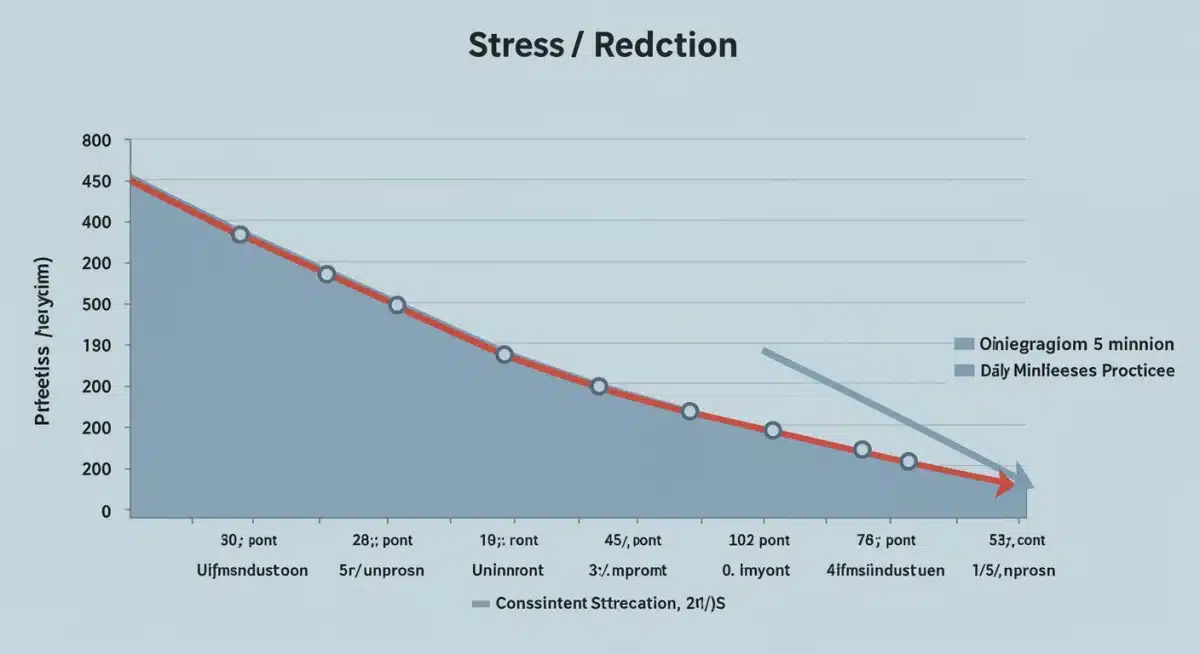
To really see that 25% stress reduction by 2026, consider a simple tracking method. You don’t need complex metrics. A mood journal where you rate your stress level from 1-10 at the beginning and end of the day, or just a simple checkmark for each successful reset, can provide valuable insights and motivation. Over time, you’ll notice patterns and the positive impact of your consistent mindfulness stress reduction efforts.
By consciously integrating these strategies, your 5-minute mindfulness reset will transform from an occasional effort into an indispensable part of your daily rhythm, paving the way for a significantly calmer and more focused life by 2026.
Measuring Your Progress: Achieving 25% Stress Reduction by 2026
The commitment to a 5-minute mindfulness reset is a powerful one, but how do you quantify its impact? How do you know you’re actually on track to achieve that 25% stress reduction by 2026? While stress is subjective, there are tangible ways to observe and measure your progress, reinforcing your efforts in mindfulness stress reduction.
1. Baseline Assessment:
Before you fully dive in, take a moment to assess your current stress levels. This creates your baseline. You can do this by:
- Self-Assessment Scale: On a scale of 1 to 10 (1 being no stress, 10 being extreme stress), what is your average daily stress level?
- Journaling: For a week, briefly jot down what triggers your stress and how you typically react. Note physical symptoms (tension, headaches), emotional responses (irritability, anxiety), and behavioral patterns (snapping at others, comfort eating).
- Simple Stress Questionnaire: A quick online search for ‘perceived stress scale’ will yield short, validated questionnaires you can use.
2. Observational Tracking:
This is where your daily 5-minute mindfulness reset starts to pay dividends. Pay attention to:
- Frequency of Stressful Moments: Do you find yourself less often in a state of high alarm?
- Intensity of Stressful Moments: When stress does arise, does it feel less overwhelming or debilitating?
- Recovery Time: How quickly do you bounce back from a stressful event or thought? Do you ruminate less?
- Physical Symptoms: Are you experiencing fewer tension headaches, less stomach upset, or better sleep?
- Emotional Reactivity: Are you less irritable, more patient, and able to respond rather than react in challenging situations?
3. Journaling for Insight and Growth:
A simple mindfulness journal can be incredibly illuminating for tracking your mindfulness stress reduction journey. Each day (or a few times a week), consider noting:
- Date and Time of Reset: When did you practice?
- Technique Used: Which 5-minute mindfulness reset technique did you employ?
- Observations: What did you notice during your practice? (e.g., “mind was busy,” “felt calm,” “noticed tension in shoulders”).
- Post-Practice Feeling: How did you feel immediately after the reset?
- Overall Daily Stress Level: A quick rating (1-10) at the end of the day.
Over weeks and months, you’ll begin to see patterns. You’ll notice how consistent practice correlates with lower stress ratings and improved well-being. This empirical evidence is a powerful motivator for continued mindfulness stress reduction.
4. Seeking Feedback from Others:
Sometimes, others notice changes in us before we do. If you feel comfortable, ask a trusted friend, partner, or colleague if they’ve noticed any differences in your demeanor, patience, or reaction to stress. Their external perspective can provide valuable validation of your mindfulness stress reduction efforts.
5. Re-evaluating Your Baseline:
Every few months, revisit your initial baseline assessment. Re-take the stress questionnaire or re-evaluate your average stress level. Compare these new figures to your initial ones. This objective comparison will vividly illustrate the progress you’ve made towards that 25% stress reduction goal by 2026.
6. The 25% Reduction Goal: A Composite View:
Achieving a 25% reduction isn’t about hitting a precise number on a single scale. It’s about a noticeable, consistent improvement across multiple dimensions: feeling less overwhelmed, reacting with more calm, experiencing fewer physical symptoms of stress, and a general sense of increased peace and control. When you combine your journaling insights, observational tracking, and periodic re-assessments, you’ll gain a holistic understanding of your progress. Celebrate the small victories, acknowledge the challenges, and trust that each 5-minute mindfulness reset is a step towards a less stressed, more mindful you.
Overcoming Common Challenges and Sustaining Your Practice
Embarking on a journey of mindfulness stress reduction, even with a simple 5-minute mindfulness reset, comes with its own set of challenges. It’s not always smooth sailing, and knowing how to navigate these common hurdles is crucial for sustaining your practice and achieving your 25% stress reduction goal by 2026.
Challenge 1: “I Don’t Have Time!”
This is the most frequent excuse, yet it’s precisely why the 5-minute reset is so revolutionary. If you truly don’t have 5 minutes, consider this: what are you spending those 5 minutes on instead? Scrolling social media? Fretfully thinking? The time is there; it’s about prioritization.
- Solution: Micro-Moments: If 5 minutes feels impossible, start with 1 minute. Or even 30 seconds. A mindful breath, a quick body scan in the elevator, a conscious sip of water. Any intentional pause is a step towards mindfulness stress reduction.
- Solution: Schedule It: Treat your 5-minute mindfulness reset like an important appointment. Block it out in your calendar.
Challenge 2: “My Mind is Too Busy/I Can’t Stop Thinking.”
This is a universal experience, not a sign of failure. The goal isn’t to empty your mind, but to change your relationship with your thoughts.
- Solution: Acknowledge and Return: Every time you notice your mind has wandered, simply acknowledge the thought (e.g., “Ah, planning thought”) and gently bring your attention back to your anchor (e.g., breath). This act of returning is the practice.
- Solution: Use a Stronger Anchor: If breath is too subtle, try a sensory scan (Technique 2) or mindful movement (Technique 4), which can be more engaging for a busy mind, enhancing mindfulness stress reduction.
Challenge 3: “I Don’t Feel Anything/It’s Not Working.”
Mindfulness is subtle, and its benefits accumulate over time. Don’t expect a dramatic shift after one 5-minute mindfulness reset.
- Solution: Patience and Consistency: Trust the process. The effects of mindfulness stress reduction are cumulative. Even if you don’t feel profound changes immediately, you are still building resilience and rewiring your brain.
- Solution: Focus on the Process, Not the Outcome: Shift your attention from ‘getting somewhere’ to simply ‘being present’ in the moment. The benefits will follow.
Challenge 4: “I Keep Forgetting to Practice.”
Habit formation takes time and repetition.
- Solution: Implement Cues and Reminders: Revisit the section on integrating your practice. Use alarms, sticky notes, or habit-stacking to make your 5-minute mindfulness reset more automatic.
- Solution: Accountability Partner: Share your goal with a trusted friend or family member. A little external accountability can go a long way.
Challenge 5: “It Feels Uncomfortable/Boring.”
Sometimes, slowing down can bring uncomfortable emotions or sensations to the surface. And yes, sometimes it might just feel a bit dull.
- Solution: Lean into Discomfort: If uncomfortable emotions arise, try to observe them with curiosity rather than immediately trying to push them away. This is a powerful aspect of mindfulness stress reduction. If it’s boredom, acknowledge it and gently return to your anchor.
- Solution: Vary Your Techniques: If one technique feels consistently boring, try another from our insider techniques list. Keep it fresh.
Sustaining Your Practice for the Long Term:
- Be Kind to Yourself: Self-compassion is paramount. There will be good days and challenging days. Don’t beat yourself up for imperfections.
- Educate Yourself: Read more about mindfulness, listen to podcasts, or join a local group. Deeper understanding can fuel motivation.
- Celebrate Small Wins: Notice and acknowledge every time you successfully complete a 5-minute mindfulness reset. This positive reinforcement strengthens the habit.
- Revisit Your ‘Why’: Remind yourself of your goal – 25% stress reduction by 2026 – and the vision of a calmer, more focused you.
By anticipating these challenges and having strategies to overcome them, you empower yourself to build a resilient and lasting mindfulness stress reduction practice. Each hurdle overcome strengthens your commitment and brings you closer to your goal of a significantly less stressed life.
The Ripple Effect: Beyond 25% Stress Reduction
While the primary goal of this guide is to equip you with insider techniques for a 5-minute mindfulness reset to achieve a 25% reduction in daily stress by 2026, the benefits of consistent mindfulness stress reduction extend far beyond this measurable target. Think of it as a ripple effect, where a small, consistent action creates widespread positive changes in your life and the lives of those around you.
Enhanced Emotional Intelligence:
Regular mindfulness practice sharpens your ability to recognize and understand your own emotions, as well as those of others. This increased emotional literacy leads to more thoughtful responses rather than impulsive reactions. You’ll find yourself navigating interpersonal relationships with greater empathy, patience, and clarity, transforming potential conflicts into opportunities for understanding.
Improved Focus and Productivity:
By training your attention through the 5-minute mindfulness reset, you naturally enhance your ability to focus for longer periods. This translates directly into improved concentration at work or during tasks, leading to higher quality output and reduced errors. The mental clutter that often impedes productivity begins to dissipate, allowing you to approach complex problems with a clearer mind.
Greater Resilience to Adversity:
Life will always present challenges. Mindfulness doesn’t eliminate problems, but it profoundly changes your capacity to cope with them. By regularly creating space between stimulus and response, you develop a mental ‘buffer’ that prevents you from being overwhelmed by setbacks. You learn to observe difficulties without becoming consumed by them, fostering a powerful sense of inner strength and adaptability.
Deeper Connections and Relationships:
When you are less stressed and more present, you become a better listener, a more engaged partner, and a more understanding friend. The quality of your interactions improves dramatically as you bring your full, mindful attention to conversations and shared experiences. This strengthens bonds and creates more meaningful connections, enriching your social fabric.
Increased Self-Compassion and Well-being:
Mindfulness inherently cultivates self-compassion. As you observe your internal landscape without judgment, you learn to treat yourself with kindness and understanding, especially during difficult moments. This internal shift is foundational for overall well-being, leading to greater self-acceptance, reduced self-criticism, and a more positive self-image. The consistent practice of a 5-minute mindfulness reset reinforces the message that you are worthy of care and attention.
Enhanced Creativity and Problem-Solving:
A cluttered, stressed mind struggles with creativity. By regularly clearing mental space through mindfulness stress reduction, you open channels for new ideas and innovative solutions to emerge. When your brain isn’t constantly in ‘fight or flight’ mode, it’s free to explore, connect disparate ideas, and approach problems from novel perspectives.
The 25% stress reduction by 2026 is a significant and achievable milestone. However, it’s merely the doorway to a much richer, more fulfilling existence. Each 5-minute mindfulness reset you undertake is an investment not just in reducing stress, but in cultivating a life of greater presence, purpose, and peace. Embrace this journey, and watch as the ripples of mindfulness transform every aspect of your world.
Conclusion: Your Path to a Calmer 2026 and Beyond
We’ve journeyed through the landscape of stress, explored the profound power of mindfulness stress reduction, and equipped you with insider techniques for implementing a powerful 5-minute mindfulness reset into your daily life. Our ambitious yet entirely achievable target of reducing your daily stress by 25% by 2026 is not just a number; it’s a commitment to a life lived with greater calm, clarity, and resilience.
Remember, the essence of this transformation lies in consistency, not perfection. Five minutes a day may seem insignificant, but the cumulative effect of these intentional pauses is nothing short of revolutionary. Each mindful breath, each moment of sensory awareness, each gentle return of a wandering mind, is a deliberate step away from the relentless tide of stress and towards an inner sanctuary of peace. You are actively rewiring your brain, cultivating new neural pathways that favor calm over chaos, presence over preoccupation.
We’ve provided you with a diverse toolkit of techniques – from the foundational breath anchor to the grounding sensory scan and the perspective-shifting gratitude moment. We’ve shown you how to seamlessly integrate these practices into your busy schedule, overcoming common challenges with practical solutions. And crucially, we’ve outlined how to measure your progress, allowing you to witness the tangible benefits of your dedicated mindfulness stress reduction efforts.
As you move forward, embrace the journey with self-compassion and curiosity. There will be days of effortless presence and days of frustrating distraction. Both are part of the practice. The key is to keep showing up, keep trying, and keep reminding yourself of the profound benefits you are cultivating. By 2026, you won’t just be 25% less stressed; you’ll be more connected, more focused, more resilient, and ultimately, more authentically yourself.
Begin today. Choose one 5-minute mindfulness reset technique, find one anchor point in your day, and commit to it. Your calmer, more centered future self is waiting. Take that first mindful breath, and step onto the path of sustainable well-being. The power to transform your relationship with stress is quite literally at your fingertips.